

Primary keyword: best farming & food expansion hytale mods for vanilla hytale servers
The best farming & food expansion Hytale mods for vanilla hytale servers are not simply the largest recipe packs or the deepest cooking systems. They are the additions a server can explain in plain language: what crops, ingredients, workbenches, recipes, buffs, and progression paths change, who can access them, and how those systems behave when a pre-release update shifts the game underneath them.
This month's Farming & Food Expansion snapshot points to Chef Quest, [NoCube's] Culinary, Orbis Delicacy, and Homesteadin, with Pre-release Patch Notes (update 6) as the official backdrop. Those examples cover recipe breadth, ingredient progression, food remodeling, crafting stations, crop systems, and buff design. For players comparing vanilla Hytale servers on the homepage, the practical question is whether food mods enrich community play without quietly rewriting survival balance.
Why Update 6 matters for farming and food mods
Update 6 matters less because of one specific food change and more because it reinforces a basic pre-release reality: Hytale systems are still moving. Any server that layers food, farming, crafting, or ingredient progression on top of a moving base game needs a maintenance policy. If a patch changes movement, inputs, items, balance, or world behavior, a cooking or farming mod can suddenly feel heavier than it did when players joined.
That is especially important for vanilla-first hytale servers because farming and food sit close to the core survival loop. Food can affect healing, stamina expectations, expedition length, trade value, base planning, group roles, and early-game comfort. Crops and ingredients can affect land use, claims, markets, and how quickly new players catch up. A server does not need to reject those additions, but it should describe the boundary before players build around it.
The strongest operators will publish a simple update policy: when mods are tested, when recipes are disabled, whether items are refunded, and whether food buffs are paused during balance reviews. The site's homepage scoring methodology treats that kind of transparency as part of server quality because players are not only choosing features. They are choosing how honestly those features are governed.
What this month's food and farming mods signal
Chef Quest is the clearest progression signal in the group. Its source excerpt describes new ingredients, crafting stations, recipes, and chef gear on a journey toward becoming a grand master chef. That can be excellent for communities that want cooking to become a profession. It is also too large to hide under a vague "small food QoL" label. A server should explain whether chef progression is optional, economic, competitive, or tied to player power.
[NoCube's] Culinary sounds more compact from the available excerpt: it adds new foods. That may fit a lighter vanilla-first layer if the foods are mostly variety, decoration, or roleplay flavor. The disclosure still matters because "new foods" can mean anything from cosmetic meal options to stronger recovery, cheaper exploration, or easier group preparation. Players should not have to guess.
Orbis Delicacy raises the balance question directly because the excerpt mentions a food remodel, more foods and ingredients, and better buffs. Buff design is where food moves from flavor into power. Better buffs can be fun, but they affect travel, combat, gathering, events, and economy. A vanilla-first server can include buffed meals only if it is honest about what those buffs do and whether everyone can access them on the same terms.
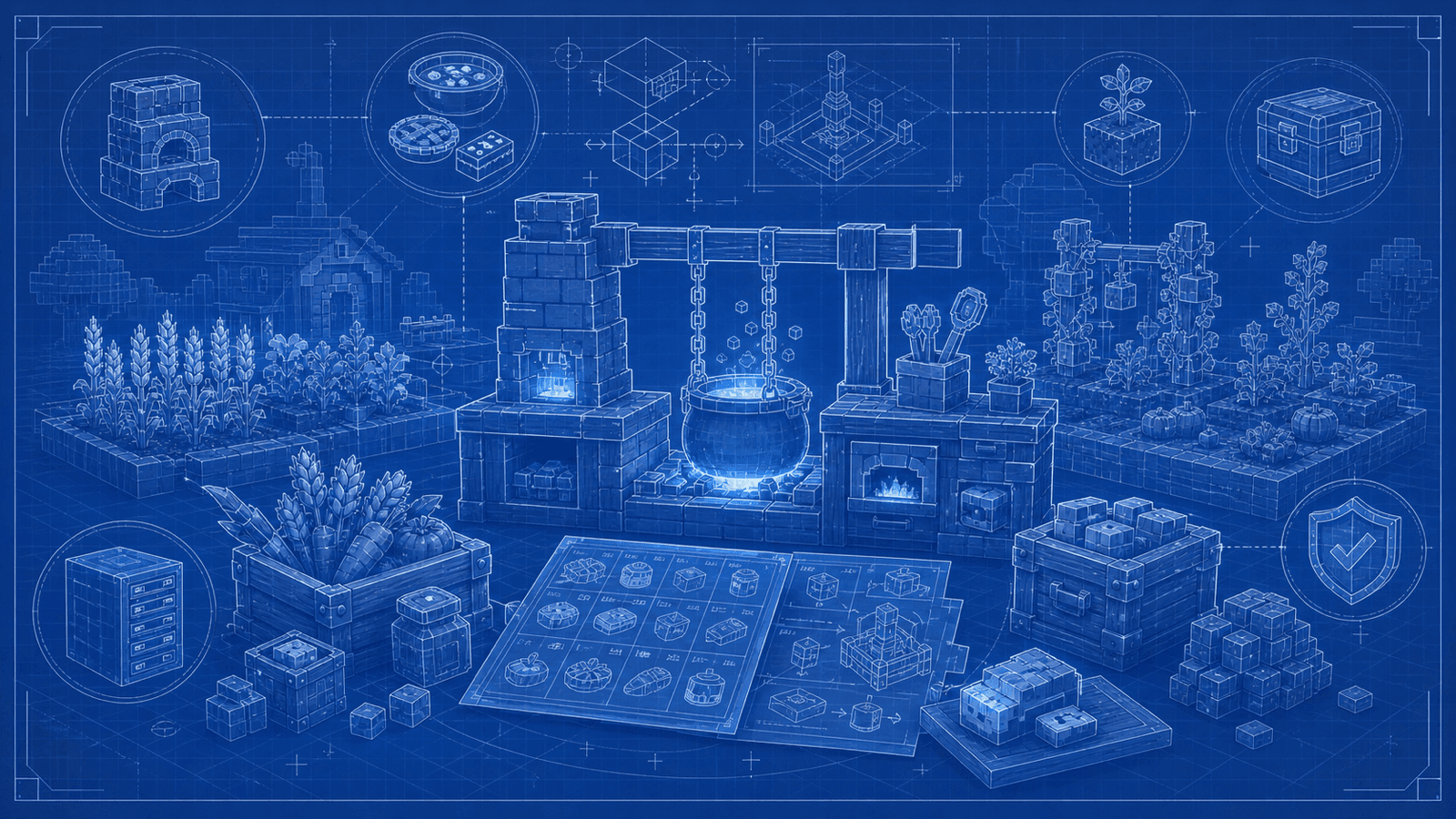
Homesteadin appears broader still: new workbenches, ingredients, crops, many food and drink recipes, an ingredient-based buff overhaul, and planned animal husbandry mechanics. That is a full server identity for the right community. It can support builders, farmers, market organizers, and roleplay groups, but it belongs in explicit semi-vanilla or expanded-survival language unless the operator can show that the core survival balance remains recognizable.
The vanilla-first filter: variety, economy, or power
The cleanest way to compare farming and food expansion mods is to sort every feature into three buckets: variety, economy, and power. Variety adds more things to grow, cook, display, or share without substantially changing what players can accomplish. Economy systems change trade, scarcity, work roles, and market demand. Power systems change survival outcomes through stronger buffs, easier recovery, faster production, or progression shortcuts.
Variety is usually easiest to reconcile with vanilla-first play. Extra meals, decorative kitchen blocks, readable recipe chains, and social cooking goals can make a server feel more alive without turning it into a different ruleset. Even then, the server should list the active mods so players know what kind of world they are entering.
Economy systems need closer review. New crops, workbenches, ingredient chains, and chef professions can create valuable trade loops. That may be a strength if the server is built around towns, markets, and cooperative farming. It becomes risky when a server claims to be nearly vanilla but lets a mod decide who controls the strongest food supply or most efficient production path.
Power systems need the clearest disclosure. Food buffs, ingredient-based bonuses, gear tied to cooking progression, animal husbandry advantages, or paid access to farming convenience can affect fairness quickly. The Hytale blog is useful here because it treats vanilla, vanilla-first, semi-vanilla, and modded as practical labels rather than status badges.
Questions to ask before choosing a server
Players should treat "vanilla with farming extras" as a claim that needs specifics. It should not take a private Discord conversation to learn whether a server uses custom crops, cooking professions, ingredient-based buffs, new workbenches, chef gear, animal husbandry systems, or paid farming convenience. Good server pages answer those questions before you join.
Start with the public rule page and mod list. If a server only says "food expansion enabled" without naming the systems, keep comparing. Stronger vanilla-first hytale servers separate cosmetic meals, social cooking, accessibility helpers, economy loops, and power-changing buffs. They also explain update testing instead of pretending every pre-release patch will be invisible.
Then compare those rules against the experience you actually want. Some players want strict survival with food kept close to the base game. Others want semi-vanilla farming towns where cooking, markets, and homesteads are a central feature. Use the server list on the homepage as a starting point, then favor communities that make the gameplay footprint easy to inspect.
Turn mod interest into better server filters
Use the blog to compare vanilla-first promises, semi-vanilla tradeoffs, and practical server-selection language.
Explore the blogBottom line for vanilla Hytale servers
This month's farming and food mods show why server-selection language has to stay concrete. Chef Quest raises progression and profession questions. [NoCube's] Culinary raises variety questions. Orbis Delicacy raises buff and balance questions. Homesteadin raises economy, crafting-station, crop, and future animal-system questions. Those are different gameplay footprints, even when they all sit under one friendly food-and-farming category.
For players, the best hytale servers are the ones whose rules match the experience they advertise. A cooking overhaul can be thoughtful, social, and fun without being vanilla. The problem starts when a server uses "farming expansion" to blur changes that affect progression, scarcity, or fairness.
For owners, the opportunity is to define the boundary now. Publish the mod list, define vanilla-first in plain language, separate variety from economy and power, and explain the Update 6 testing policy. Farming and food expansion mods can strengthen vanilla hytale servers only when they remain subordinate to fair play, transparent rules, and a survival loop players can still recognize.