

Primary keyword: best multiplayer must hytale mods for vanilla hytale servers
The best multiplayer must Hytale mods for vanilla hytale servers are the ones a community can explain before anyone commits time to the world. Party tools, faction management, personal vaults, and revive systems can make group play smoother, but they also sit close to travel, risk, storage, combat recovery, and social power. That makes disclosure more important than hype.
This month's Multiplayer Must snapshot points to Party Mod | Simple Party | Team & Squads, [Tblack's] VoidVault, ElbaphFactions, and DarkFalling, with Pre-release Patch Notes (update 6) as the official backdrop. For players comparing vanilla Hytale servers on the homepage, the useful question is not whether multiplayer mods are good or bad. It is whether the server tells you exactly which coordination systems change the baseline survival loop.
Why Update 6 matters for multiplayer mods
Update 6 matters because multiplayer servers live or die on predictable rules. Even when a patch note is not directly about factions or parties, a pre-release update can affect movement, inputs, items, permissions, interfaces, or server-side expectations. A small coordination mod can become a major operational problem if it breaks during an event, changes revive behavior, or leaves players uncertain about inventory access.
That is especially true for vanilla-first hytale servers. Multiplayer convenience is never just convenience when it changes how groups move, recover, store resources, or organize power. A party teleport can shorten geography. A personal vault can soften loss and logistics. A faction hierarchy can shape politics. A downed-state revive can change the cost of risky fights. None of those ideas are automatically wrong, but each one needs a visible boundary.
The best operators will publish a plain update policy: which multiplayer mods are active, which commands are enabled, how patches are tested, what happens when a tool is disabled, and whether staff can override any player-facing system. The site's homepage scoring methodology treats that kind of transparency as part of server quality because players are choosing governance, not just features.
What this month's multiplayer mods signal
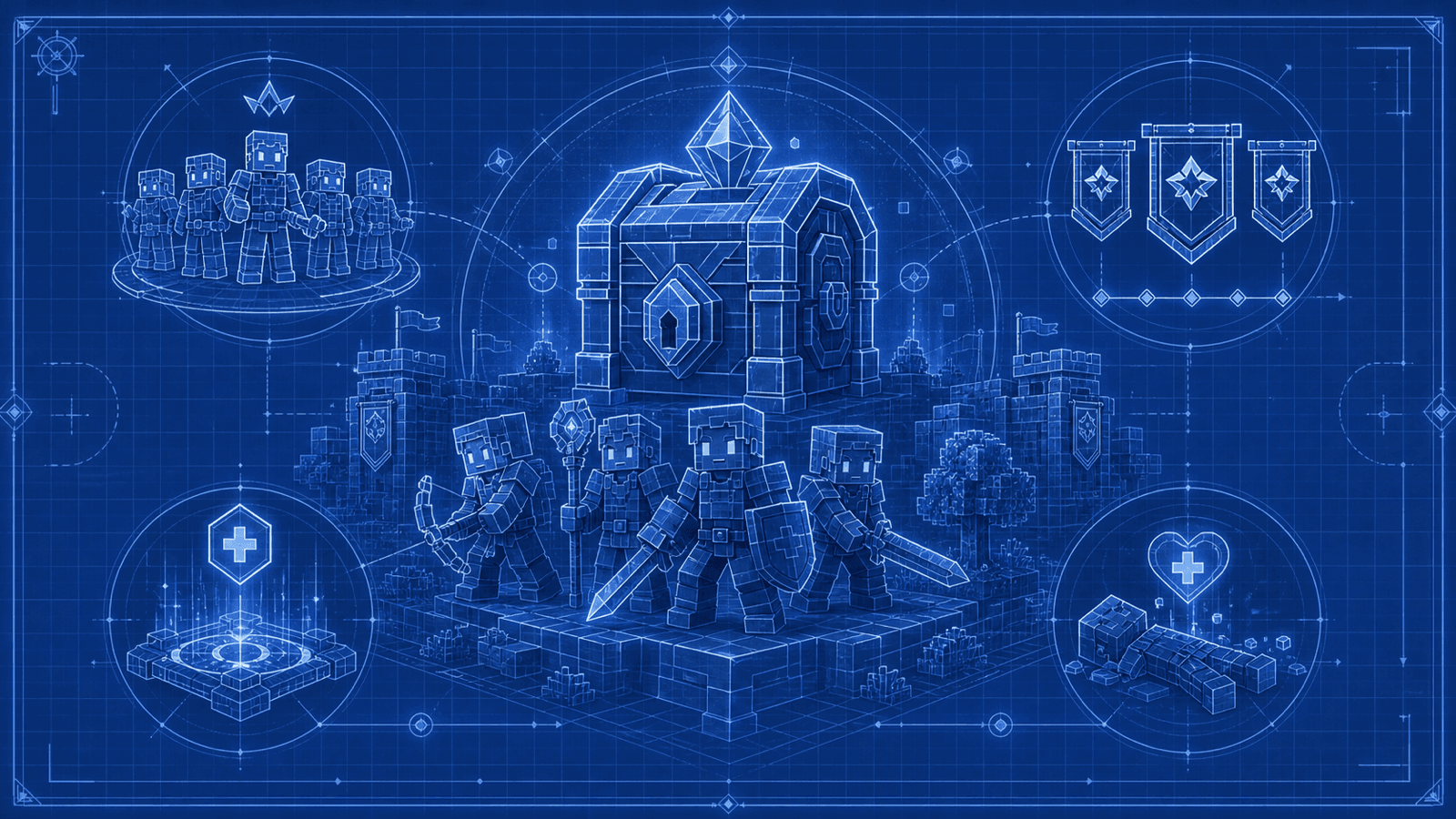
Party Mod | Simple Party | Team & Squads is the clearest coordination signal. The source excerpt describes grouping with friends, seeing each other's HP or stamina, teleporting to party members, and disabling PvP. Those are powerful group features. Health visibility can improve teamwork, teleporting can bypass distance, and party PvP toggles can change how conflict works. A vanilla-first server should say which parts are enabled and why.
[Tblack's] VoidVault raises the storage question. Its excerpt describes a personal cross-dimensional vault for every player, similar to an Ender Chest. Portable or cross-dimensional storage can be practical, but it affects risk, travel planning, scarcity, theft pressure, and expedition length. If every player has private vault access, the server should explain whether that is a baseline rule, a progression unlock, an event reward, or a supporter perk.
ElbaphFactions is a governance signal. The available description points to clan management, rank hierarchies, diplomacy mechanics, and faction chat for organized team play. Those systems can support large communities well, but they define social power. A server using factions should explain claim rules, rank authority, diplomacy expectations, moderation boundaries, and whether solo players can still compete or live comfortably.
DarkFalling is a risk signal because the excerpt says it replaces instant death with a downed state, allowing players to be revived before they die. That can create better group moments and reduce accidental frustration. It can also change combat stakes, exploration danger, and the cost of bad decisions. The rule page should say when revives work, who can revive, whether PvP uses the same rules, and what happens to items during the downed window.
The vanilla-first filter: coordination, logistics, or power
The cleanest way to compare multiplayer must mods is to sort every feature into three buckets: coordination, logistics, and power. Coordination features help players communicate, form groups, or understand teammates. Logistics features change movement, storage, recovery, claims, or resource flow. Power features change combat outcomes, faction authority, safe access, or paid advantage.
Coordination is usually the easiest fit for vanilla-first play. Party lists, team chat, readable group status, and clear faction communication can make a server more legible without replacing survival. Even then, the server should list the active systems so players know whether they are joining a small-community SMP, a faction world, or a semi-vanilla coordination-heavy server.
Logistics needs a closer look. Teleports, vaults, faction homes, revive recovery, and shared storage can all compress the cost of distance or loss. That may be healthy on a casual community server, but it should not be hidden behind the phrase "mostly vanilla." Players searching a hytale server list need to know whether geography, inventory risk, and group travel still matter.
Power needs the clearest disclosure. Rank permissions, diplomacy tools, PvP toggles, revive priority, vault access, and any monetized multiplayer utility can affect fairness quickly. The Hytale blog is useful here because it treats vanilla, vanilla-first, semi-vanilla, and modded as practical labels rather than status badges.
Questions to ask before choosing a server
Players should treat "vanilla with multiplayer helpers" as a claim that needs specifics. It should not take a private Discord conversation to learn whether a server uses party teleports, faction permissions, private vaults, revive states, PvP toggles, or staff-managed group tools. Good server pages answer those questions before the join decision.
Start with the public rule page and mod list. If a server only says "multiplayer must-haves enabled" without naming the systems, keep comparing. Stronger vanilla-first hytale servers separate communication helpers, moderation tools, logistics changes, faction politics, and power-changing systems. They also explain update testing instead of pretending every pre-release patch will be invisible.
Then compare those rules against the experience you actually want. Some players want strict survival where travel, loss, and group risk stay close to the base game. Others want semi-vanilla worlds built around clans, revives, vaults, and organized events. Use the server list on the homepage as a starting point, then favor communities that make the gameplay footprint easy to inspect.
Turn mod interest into better server filters
Use the blog to compare vanilla-first promises, semi-vanilla tradeoffs, and practical server-selection language.
Explore the blogBottom line for vanilla Hytale servers
This month's multiplayer mods show why server-selection language has to stay concrete. Simple Party raises coordination, teleport, status, and PvP toggle questions. VoidVault raises storage and travel questions. ElbaphFactions raises politics, rank, diplomacy, and group power questions. DarkFalling raises death, recovery, and combat-risk questions. Those are different gameplay footprints, even when they all sit under one helpful multiplayer category.
For players, the best hytale servers are the ones whose rules match the experience they advertise. A party system can be thoughtful and social without being vanilla. A faction suite can be well-governed and still belong in explicit semi-vanilla language. The problem starts when a server uses "multiplayer must" to blur features that affect progression, scarcity, risk, or fairness.
For owners, the opportunity is to define the boundary now. Publish the mod list, define vanilla-first in plain language, separate coordination from logistics and power, and explain the Update 6 testing policy. Multiplayer must mods can strengthen vanilla hytale servers only when they remain subordinate to fair access, transparent rules, and a survival loop players can still recognize.